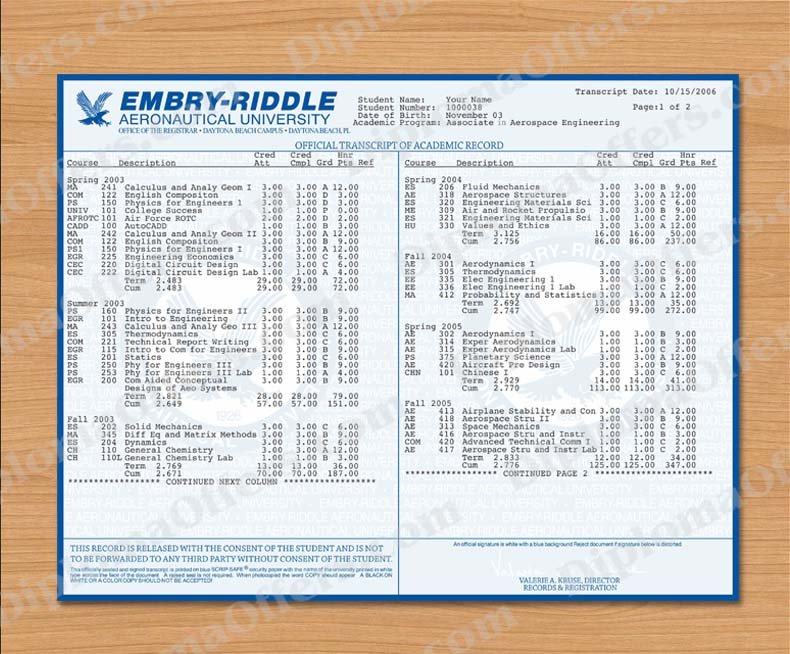
You request a transcript from the registrar of the school that issued it — or from the school district, the state archive, or the state GED office if the school has closed or the credential was a GED. Most requests cost $5–$20 and take three to ten business days.
What people get wrong is not the request itself, it is which office to ask and which version to send. Those two mistakes account for most of the delays.
Official vs unofficial transcripts
| Official transcript | Unofficial transcript | |
|---|---|---|
| How it is issued | Sealed, stamped, or sent directly by the registrar | Printed from a portal or emailed as a PDF |
| Accepted by | Employers, colleges, licensing bodies, credential evaluators | Yourself, for reference or a preliminary check |
| Cost | Usually $5–$20 per copy | Usually free |
| Delivery | Sealed envelope or secure electronic service | Download or email |
| Opening it | Do not open it. A opened official transcript is no longer official | No restriction |
The single most common mistake: ordering an official transcript, opening the envelope to check it, then sending it on. Once the seal is broken, most institutions will reject it and you will pay for another.
Where to request, by situation
The school is still open
Contact the registrar’s office directly. Most schools have an online request form, a fee, and a processing window of three to ten business days. Some use a third-party service — Parchment, the National Student Clearinghouse, or a state system — which handles delivery to colleges and employers electronically.
The school has closed
The records moved somewhere. Ask the district office first: "where are the student records for [school], closed in [year]?" If the district is also gone, the state archive or department of education usually holds them. If the school merged, the successor institution has the record. This is covered in more detail in school closed: how to get your records.
The credential was a GED
Contact the state GED administrator, not a school. Every state has one, and most publish an online request form. Expect a fee per copy and a shorter turnaround than a school district. GED transcripts are one of the more commonly requested documents, and the process is usually simpler than people expect.
You are applying to college or an employer
Ask them first whether they accept an electronic official transcript. Most colleges and many employers do, and electronic delivery is faster and cheaper than paper. If they require paper, it must arrive sealed from the institution — not forwarded by you.
What you need before you request
- The name you were enrolled under — including any maiden name or spelling variation
- Dates of attendance or graduation year
- Date of birth
- Student ID or Social Security number, if the institution asks for it (many do, for identity verification)
- The recipient’s address or email, if it is being sent directly
- Payment — card details, or a cheque in some districts
If you changed your name, expect to provide documentation linking the two. A request that does not match the enrolment record is the second most common cause of delay.
Cost and timeline
| Request route | Typical cost | Typical time |
|---|---|---|
| High school registrar | $5–$15 | 3–10 business days |
| College registrar | $10–$25 | 2–7 business days |
| Electronic service (Parchment, Clearinghouse) | $5–$15 | Same day to 3 days |
| State GED office | $5–$20 | 5–15 business days |
| State archive (closed school) | $0–$25 | 2–8 weeks |
Rush options exist at many institutions for an extra fee. State archives are the slowest link, and there is usually no expedite option.
Five mistakes that delay a request
- Requesting from the wrong body. A closed school’s records are not at the school. A GED is not issued by a school at all.
- Opening the sealed envelope. It voids the official status.
- Sending an unofficial copy to an employer who asked for an official one. Check which one they asked for.
- Using a different name from the enrolment record without documentation.
- Assuming the fee is waived. It usually is not, though some districts waive it for active-duty military or for transcripts sent to in-state colleges.
If you cannot obtain one
Two routes remain. A verification letter from the institution or archive states that the record exists and what it shows, and some employers accept it where a transcript is not strictly required. Otherwise ask the receiving organisation what alternative evidence it will take — that conversation is worth having before you spend money on anything else.
Transcripts vs diplomas
A transcript records the coursework: courses, credits, grades and a cumulative summary. A diploma records only the award. Employers and colleges usually want the transcript because it is the document that carries detail. The full comparison is in diploma vs transcript.
If what you are actually replacing is the diploma rather than the transcript, see lost diploma: what to do.
What a transcript actually contains
Before you pay for a copy, it helps to know what you are getting. A standard transcript lists:
- Every course taken, by term, with the title and course code
- Credit value for each course
- The grade awarded, in whatever scale the institution uses
- Term and cumulative GPA (or a classification, in UK and Commonwealth systems)
- Academic standing notes — probation, honours, withdrawal codes
- Degree awarded and conferral date, once it has been granted
- Institution identification, seal or stamp, and a registrar signature or verification code
What it does not contain is any detail about the diploma as an object: the size, the paper, the seal design. That is a different document, which is why the two are usually stored together and asked for separately.
Electronic or paper: which to order
Electronic delivery has become the default for college applications because it is faster, cheaper and verifiable. The transcript is sent as a secure PDF or through a service that the receiving institution can validate.
Paper still matters in three situations: some professional licensing boards, some international credential evaluations, and some employers with paper HR files. In each case the transcript must arrive sealed — forwarded copies are rejected.
If you are unsure, ask the recipient one question: do you accept an electronic official transcript? That single question decides the route, and it costs nothing to ask before you pay for the wrong one.
Common questions
Can I request a transcript online?
Usually yes. Most schools and all state GED offices accept online requests. Some still require a signed form by post or fax.
How long does it take?
Three to ten business days for a school, same day to three days for an electronic service, and two to eight weeks for a state archive.
Does it expire?
No, but many colleges and employers require one issued within the last six to twelve months. Check the receiving institution’s rule before ordering.
Can I get a transcript if I graduated decades ago?
Usually yes. Older records may be on microfilm or in an archive, which adds time. The institution may charge a research fee.
What if I only need it for my own reference?
Request the unofficial copy. It is usually free and instant, and it is enough for checking dates and grades.
Everything sold on this site is a novelty reproduction for display, keepsake and prop use. It is not an official record and cannot be used to verify a qualification.
If the credential was a GED rather than a school diploma, the route is different: see GED transcripts.