Losing a diploma feels worse than it is. The document is replaceable in most cases, the process is more routine than people expect, and there are clear steps depending on whether you need it for something formal or just want it back on the wall. Here’s the full picture.
Step 1: Contact the school, not the district
Replacement diplomas are issued by the institution that awarded them. Start with the registrar, the records office or the alumni office — whichever your school lists for transcript and diploma requests. A phone call usually tells you within two minutes who handles it and what they need, which saves a week of email.
If you’re not sure the school still exists, skip to the section below on closed institutions before doing anything else.
Step 2: Have your details ready
Records offices search by student identity, not by document, so expect to provide:
- Your full name as it appeared at graduation (including a maiden name, if applicable)
- Year of graduation, or the approximate dates you attended
- Date of birth
- Student ID number, if you still have it on any paperwork
- The program or major, for college documents
- Photo identification
If your name has changed since graduation, mention both names in your first message. It prevents the request being rejected on a name mismatch and re-opened a week later.
Step 3: Expect a fee and a wait
Costs vary widely. Many US high schools charge somewhere between $10 and $50 for a replacement diploma; universities tend to sit at the higher end, and some institutions charge separately for the diploma and the transcript. Turnaround is typically two to eight weeks, longer around graduation season when records offices are at their busiest.
Two things worth asking on the first call: whether they issue a reprint of the original design or a current-design replacement, and whether the document will carry a notation indicating it is a duplicate. Some schools print “reissued” on replacements, which matters if the document will be displayed.
Step 4: If the school has closed
Closed institutions are more common than people realise, and there is usually a paper trail. Try, in this order:
- The district or system office. Records from a closed school are often transferred to the district that oversaw it.
- The state archives or department of education. Many states hold transcript and graduation records for defunct institutions and can issue certified copies.
- A successor institution. Schools that merged usually leave one institution holding the records of both.
- Accrediting bodies. They can confirm where records went, even if they don’t hold them.
Be cautious with third-party “diploma replacement” services that promise a document from a closed school without any records check. If a company will produce a document without verifying your graduation, what it is selling is not a replacement — it’s a novelty item, and it cannot be used as proof of anything.
Step 5: Decide what you actually need
This is the part most guides skip. There are two genuinely different needs, and they have different solutions.
If you need to prove your qualification — for an employer, a licensing body, a university application or a visa — the only valid route is the issuing institution or the state records office. A duplicate from the school carries real weight; nothing else does.
If you want the document back on the wall — to replace one that was lost in a move, water-damaged in storage, or simply never framed — a display copy is a reasonable, inexpensive option. It is a reproduction: a faithful copy of the layout and typography, produced for display, keepsakes or props. It is not an official record and cannot verify anything.
What a display copy is — and isn’t
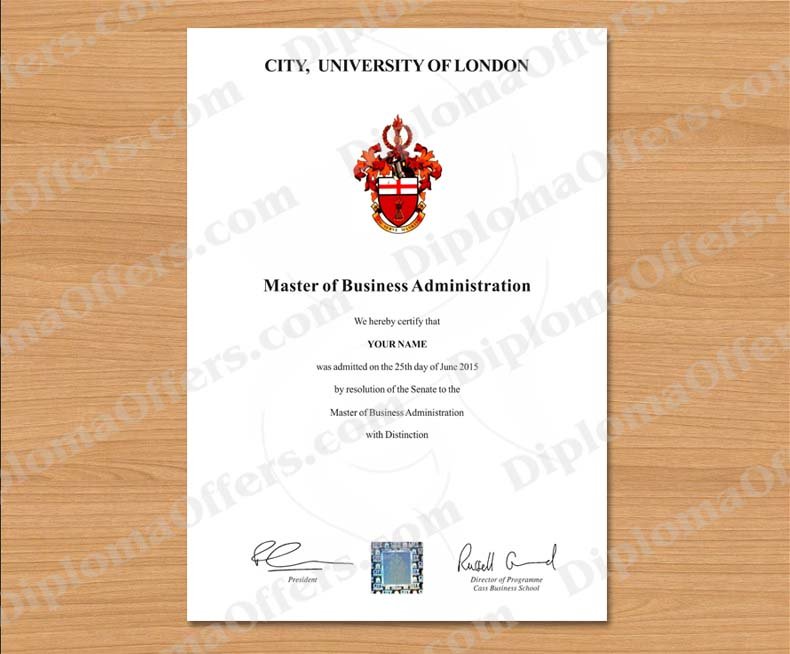
A good novelty replica matches the look of the original: paper weight, layout, typeface, seal placement. People order them to restore a framed piece, to keep the original safely stored, or to replace a document that was lost years ago and would cost more to reissue than the wall is worth.
What it isn’t: it is not issued by a school, it carries no official standing, and it can’t be verified by a registrar. Sellers who imply otherwise are a warning sign. If you want the full breakdown of where the line sits, we covered it in Replica Diploma vs Real Diploma, and in Is It Legal to Buy a Novelty Diploma?.
Ordering a display copy that actually matches
Three details decide whether the result looks right on the wall:
- Size. Match the original document size so it drops straight into the existing frame. See the size table in our framing guide.
- Layout and wording. The position of the seal, the signature block and the institution line matter more than the font. Send a photo of the original if you have one; if you don’t, describe the era and region and the layout can be matched from reference.
- Format. Digital-only is cheapest and fine if you’re printing locally; printed and shipped is simpler if you want the right paper stock.
You can browse by document type — high school diplomas, GED diplomas and score reports, transcripts, or degree diplomas — and pricing is set out item by item in How Much Does a Replica Diploma Cost?
If you’re unsure about paper weight or finish, request a free paper sample first. It costs nothing and settles the question faster than any description.
After it arrives
Store the document flat and out of direct light until you’re ready to frame it. When you do frame it, use a mat and UV-filtering glazing — paper that has already been lost once deserves better than a $10 frame pressed against the kitchen window.
Common questions
How long does a replacement diploma take?
Usually two to eight weeks from a school records office. State archives can be faster or slower depending on the state. Ask for an expected date on your first call.
Can I get a replacement if I graduated decades ago?
Almost always yes. Schools retain graduation records indefinitely, and state archives hold records for closed institutions. Older records sometimes require a manual search, which adds time.
Is a replacement diploma marked as a duplicate?
Sometimes. Policies vary — some schools reprint the original design, others add a notation. If the appearance matters, ask before ordering.
Can I use a novelty replica as proof of graduation?
No. A replica is a display item. Using it to represent your qualifications would be misrepresentation, and no legitimate seller will support that use.
The short version
For anything official: call the registrar, have your graduation details ready, pay the fee, wait a few weeks. For the wall: match the size and layout, order a display copy, and frame it properly. Those are two different jobs, and it’s worth being clear with yourself about which one you’re doing.
Related guides
- How to Replace a Lost High School Diploma — high school replacement, step by step
- Choosing a Replacement Diploma or Transcript — common uses and how to choose
- Replica Diploma vs Real Diploma: Key Differences — display copy vs official reissue