Associate, bachelor, master, doctorate — four levels, four very different documents. If you are ordering a display copy, or simply trying to work out which credential sits where, this is the short version.
At a glance
| Level | Typical length | Credits | What the document shows |
|---|---|---|---|
| Associate | 2 years | ~60 | Program name, institution, conferral date |
| Bachelor | 4 years | ~120 | Degree title, major, honours, signatures |
| Master | 1–2 years | ~30–60 | Formal wording, often Latin, larger seal |
| Doctorate | 3–6 years | varies | Large format, dissertation field, formal formula |
Associate degree
A two-year credential, usually awarded by a community college. The diploma is compact: the program, the institution and the conferral date, with a smaller seal than a bachelor’s document. It often names the specific award — Associate of Arts, Associate of Science, Associate of Applied Science.
Because the layout is simpler, an associate diploma is one of the easier documents to reproduce accurately. The detail that matters most is the exact award wording.
Bachelor degree
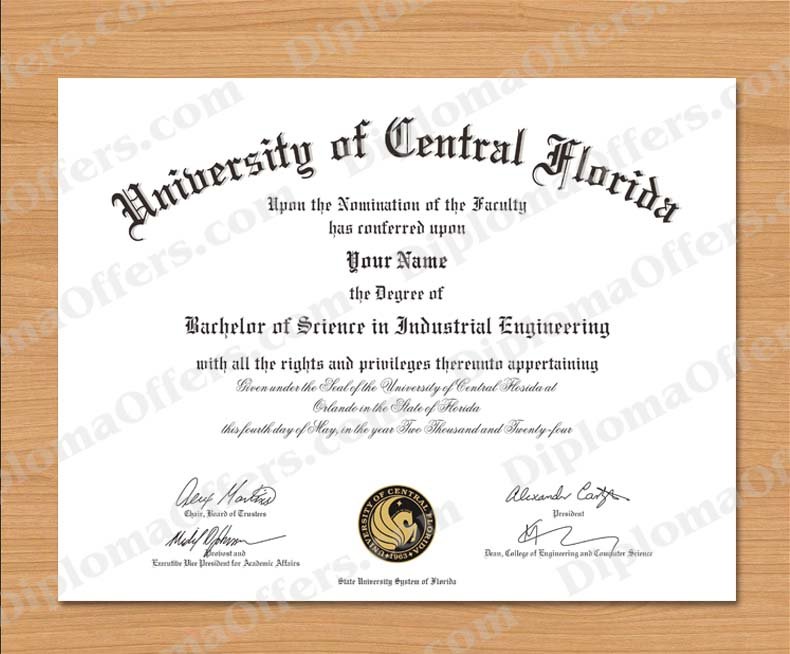
The most commonly framed degree document. It carries the degree title (BA, BS, BSc, BEng), the major or field, the institution, the conferral date and two or three signature lines — typically the president, the provost and the dean.
Honours wording is where most errors creep in: cum laude, with honours, first class and similar phrases are placed differently depending on the school and the country. If you are matching an existing document, send a photo.
Master degree
Master’s diplomas tend to be more formal than bachelor’s documents. Many use Latin phrasing — Magister Artium, Scientiae Magister — and a larger seal. The layout is usually the same size (8.5 × 11 in the US, A4 in the UK and EU) but with denser text.
The visual giveaway is the wording, not the size. If the original used a Latin formula, the replica needs the same formula in the same position.
Doctorate
Doctoral diplomas are the outlier: often larger than the other three, with elaborate borders and a formula that names the degree, the field of the dissertation and the conferring body. Some institutions issue two documents — the diploma and a separate certificate of degree.
If you are framing one, check the size before ordering a frame. An oversized doctorate diploma will not fit a standard 11 × 14 opening without cropping the border.
How the documents differ visually
- Size — associate and bachelor are usually letter; doctorate is often larger.
- Wording — bachelor uses plain English; master and doctorate often use Latin formulas.
- Seal — grows with the level, and moves position between institutions.
- Signatures — two for associate, two to three for bachelor, sometimes four for doctorate.
Which one should you order?
Order the level of the document you are replacing or displaying — not the one that sounds most impressive. The point of a display copy is that it matches what belongs on that wall.
Browse the level directly: associate, bachelor, master, doctorate. Sizes and mat widths are covered in the framing guide.
Every document we make is a novelty reproduction for display, keepsakes and props. None of them are official records or verifiable qualifications.
Common questions
Is an associate degree a real degree?
Yes — it is a two-year undergraduate credential, distinct from a bachelor’s degree but awarded by an accredited institution.
What size is a master’s diploma?
Usually 8.5 × 11 inches in the US and A4 elsewhere, the same as a bachelor’s document. The wording differs more than the size.
Can a doctorate diploma be framed?
Yes, but check the dimensions first. Oversized documents need a frame large enough to keep the border visible.
Related guides
- GED vs High School Diploma: What’s the Difference? — the high school equivalency comparison
- Replica Diploma vs Real Diploma: Key Differences — replica vs official record
- How to Frame a Diploma: Sizes, Matting & Display Ideas — framing by document size